

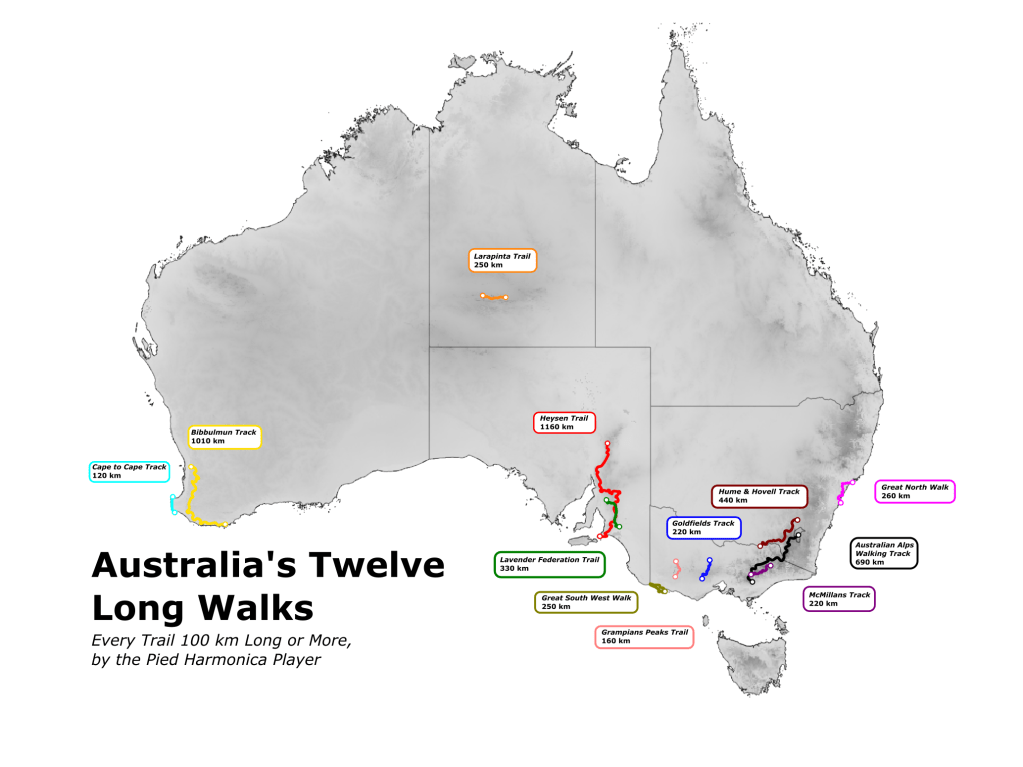
There’s something special about long walks.
I’m not just talking about your prolonged wander through the local gorge, or even camping out. I’m talking about the long ones: walks in which you hike, and hike, and hike, until distant ridges that were a smudge on the horizon a week before are being climbed, yielding a vast landscape on the other side you know you will walk all the way across. I’m talking about hikes so ridiculously long that it becomes actively idiotic to try and pack all the food you need for the hike at the initial trailhead, where you need to instead cache your food, or even buy it along the way. Walks so long they stop being walks, and become journeys. Pilgrimages, if you prefer.
At first glance, Australia isn’t blessed with the kind of famous long distance trails its companions in the Anglosphere enjoy. The United States has its legendary Triple Crown, and even Australia’s little sister New Zealand hosts the frequently enjoyed Te Araroa. Still, Australia has a lot of unusual and fascinating tracks out there, just waiting to be discovered by the adventurous hiker. For foreign hikers, they offer a way to see swathes of this immense continent on the cheap. For Aussies, they’re an ideal way to ditch the expense of a plane ticket to the States and explore one’s own vast and, for the most part, underappreciated backyard the hard and rewarding way. I’ve had the privilege do hike a couple of walks on this list myself. They build character at their worst and are spectacular at their best. Read this list below, and get inspired to plan your own hike.
There are ‘tracks’ missing on this list, the Bicentennial National Trail to name one. That’s because we aren’t counting routes made primarily for horses or bikes; just ones designed and signposted for travel on two feet.
12. Cape to Cape Track, WA (120km)
- Days: 5-8
- Standard: Easy
- Resupply: Margaret River
- Campsites: Yes, four free ones and multiple resorts/caravan parks
The Cape to Cape Track is one of the longer examples of a ‘tourist’ trail in Australia. Guided groups are frequent and people are never too far away. As it turns out, the tourists are here for a reason. The track spans the distance between two of the most prominent capes in Western Australia – Cape Naturaliste and Cape Leeuwin – and hugs the coast for the entire week-long journey. Aspiring hikers should expect good trails, better clifftop scenery, and long beachwalks, especially on the last couple days. Hikers enjoy four well-provisioned free campsites. Due to the track’s short length, resupply isn’t really an issue for fit hikers.
11. Grampians Peaks Trail, Vic (160km)
- Days: 13
- Standard: Easy-Medium
- Resupply: Halls Gap
- Campsites: Yes, twelve ($47 per plot per night)
On the far southwestern end of the Great Dividing Range lie the Grampians, an abrupt set of rocky and diverse ranges. It is home to a brand-new hiking experience that is well serviced, well built, and truly world class. Too bad the bastards charge $47 per night for it. While the project has been criticized from its outset and remains divisive for the Victorian outdoor community, no one is denying its status as an unusual trail winding its way through some of the best outdoor scenery Victoria has to offer. A truckload of information about the trail can be found on the Parks Victoria website, so head there if this sort of walk inspires you.
10. Goldfields Track, Vic (220km)
- Days: 10-15
- Standard: Easy
- Resupply: Creswick, Daylesford, Castlemaine
- Campsites: Yes, plus five towns
Connecting large towns that once served as goldrush hubs, The Goldfields Track is ideal for history buffs or those who simply want to relax by taking a long, long walk in the woods. The Track is getting more popular with mountain bikers, but the trails tend to be wide enough for both groups to safely share. In terms of logistics, it’s a distance hiker’s dream; short days split by good campsites, frequently ending in a nice town with a selection of pubs and restaurants. This track isn’t as beautifully manicured as the earlier ones on this list, however, and starts a trend on this list of nailed arrows pointing the way down dirt roads and maintenance tracks. If that’s your thing, you’ll like it.
9. McMillans Track, Vic (220km)
- Days: 12-16
- Standard: Medium-Hard
- Resupply: None (Find a way to cache food)
- Campsites: Few to no serviced ones
Few purpose-built Aussie tracks are so scenic and historic while being so incredibly vague. In 1864, Angus McMillan and his team cut an eight foot wide track traversing the southern parts of the Australian Alps. The track went from just about nowhere to just about nowhere, so it was slowly abandoned and left to decay into nothing. Over a hundred years later, some strikingly dedicated members of the Ben Cruachan Walking Club repeated McMillan’s feat and reopened the trail with some assistance from Parks. As it is, without continuing work by the club and the publishing of an official guidebook by John Chapman (the ‘GOAT’ of Australian hiking guidebook authors) the track would probably have overgrown back to its original state by now. For now, it’s a sweet challenge of a trail skirting around some of Australia’s tallest peaks. Do as much research as you can for this track; there really isn’t much info for it out there.
8. Great South West Walk, Vic/SA (250km)
- Days: 12-16
- Standard: Easy (unless you dislike beach walking)
- Resupply: Nelson (limited)
- Campsites: 14, $5 a night
One day, a Parks employee was staring at a map and noticed that the series of parks in his local area formed an oblong and bloated circle. Not much later, this unique, 250km loop trail was cut. Whether the scenery is consistently good or not is a matter of taste. On my 2022 thru-hike, I found that a hundred kilometres of walking through the exact same kind of dead-flat swampy forest wilderness is the kind of tedium I don’t like. You’ll find all kinds of wildlife through that forest, at least – including leeches. Anyway, it isn’t a walk to be purely judged on its infamous Cobboboonee Forest section. Much of it follows clifftops on the Glenelg River, or the coast. The coastal bit features the tallest seaside cliff in Victoria, on a 60km track section that rivals the actual Great Ocean Road for scenery. There is also a 60km beach you will spend no less than three days walking down. Liking this bit may also be a matter of taste. I loved it. Besides the scenery, the track itself is purpose-built and beautifully well maintained (surprising given the lack of popularity) and campsites are elegantly well designed. If you can’t be bothered sending a resupply box to Nelson, I would suggest starting the loop in Nelson so you can resupply fully in Portland.
7. Larapinta Trail, NT (250km)
- Days: 12-17
- Standard: Easy-Medium
- Resupply: None (car access everywhere)
- Campsites: Yes (41, 12 are paid)
This track needs little introduction for outdoor enthusiasts, even for many overseas. It’s one of those tracks on the Overland-Thorsborne-Larapinta circuit that overseas hikers crave, and may just be the most uniquely Australian track of the three. The Larapinta Trail makes its way through the best of the Macdonell Ranges, a region heavily bisected by gorges. The track is surprisingly varied and rarely unscenic. There are no towns on the trail, which might make a distance hiker worry until finding out that there are many access points to the trail and a lot of them have lockers for food drops. I know several people who call the Overland Track overrated. None say the same for the Larapinta. So if you feel like some desert roaming, head to Alice Springs in the heart of the Red Centre and start walking.
6. Great North Walk, NSW (260km)
- Days: 10-18
- Standard: Medium-Hard
- Resupply: Numerous – Newcastle, Teralba, Somersby, Patonga, Brooklyn, suburbs of Sydney
- Campsites: Yes, numerous unpaid
Want to do a long distance hike? Don’t want to deal with huge car shuffles or bus trips to the middle of nowhere? This track conveniently removes that excuse for you. The Great North Walk, one of the most popular tracks on this list, connects central Sydney to the coal port city of Newcastle using a surprisingly large amount of local reserves and national parks. The tracks the Walk strings together are good and adventurous, swinging regularly over hilltops and into chasms. Explore the sandstone country of Broken Bay, the wild Watagans, the beaches of Newcastle, and everything in between. Many lodges, B&Bs, and hotels exist on trail, but in my opinion the best way to explore the hills just outside Australia’s biggest city is to bush camp in the traditional way. Warning: Considering how low the trail’s highest point is, it’s surprising how much vertical gain the route planners squeezed into it.
5. Lavender Federation Trail, SA (320km)

- Days; 14-16
- Standard: Easy-Medium
- Resupply: Springton, Truno, Eudunda, Mintaro (all limited)
- Campsites: None
The volunteer team behind the Heysen Trail weren’t satisfied with their magnum opus, so they made this thing. I won’t lie; I didn’t get the best impression from my research on this trail. It essentially zigzags through farmland on the straightest possible route from the dust pit town of Murray Bridge to the bloated village of Clare, exclusively following roads or untracked fences and somehow missing all the obvious points of interest between the towns. It has no campsites, so hikers are encouraged to stay in B&Bs and hotels, but hikers invariably camp illegally in paddocks instead (because long-distance hikers are dirtbags). On reflection, there’s actually some merit to this kind of hike, however. The farmland has some muted charm to it and you feel happy not being led by the hand down over-maintained trails all the time. Not all hikers like this kind of walk, but this is here for those who do.
4. Hume and Hovell Track, NSW (440km)
- Days: 18-26
- Standard: Medium
- Resupply: Tumut, Tumbarumba, Holbrook (good but spaced)
- Campsites: Numerous, free
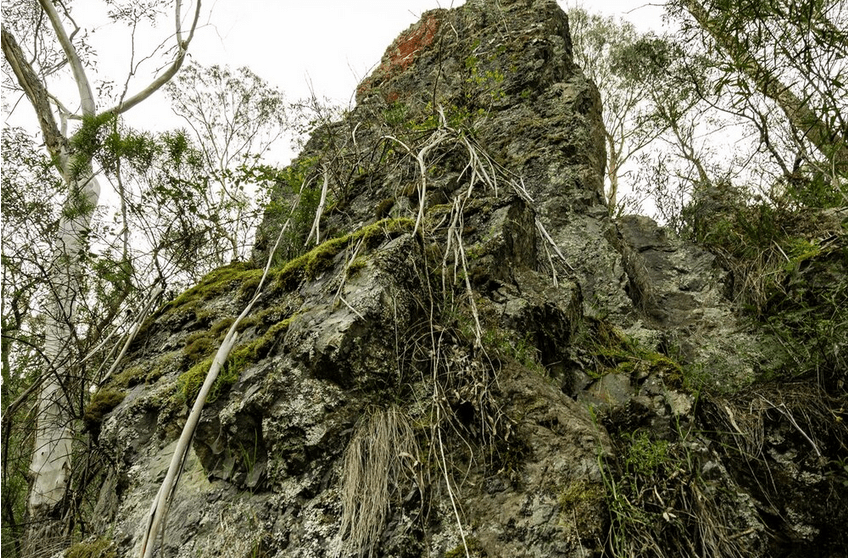
The Hume and Hovell is a solidly good track that cuts its way into some truly scenic wilderness. The track makes use of suspension bridges and even a ferry to traverse tall forests on the fringe of the Snowy Mountains, following the route of two explorers. Granted, it doesn’t have as many of those postcard picture moments as some nearby rivals enjoy, but it really isn’t a waste of time. Towns dot the route, but can be a bit spaced resulting in either large food hauls or resupply caches being needed. The track both starts and ends at towns on the Hume Highway, making transport to either trailhead fairly straightforward.
3. Australian Alps Walking Track, Vic/NSW/ACT (690km)
- Days: 25-45
- Standard: Hard
- Resupply: Mount Hotham and Thredbo. You’ll want to organise food caches.
- Campsites: Free bush camping on much of route
Now we’re really getting into the meat and bones of this list. The Australian Alps Walking Track travels from near Melbourne to near Canberra. It has been called the toughest track in Australia by some, and they may just be right. Looking at a topo, it’s hard to visualize a trail undulating more violently. Vertical gain per unit of distance is higher than that of the Appalachian, and track standard is so, so much worse. So, why do people return to the track year after year? Maybe it’s the fact it links all the tallest peaks in Australia by unrelentingly following the highest ridges of the Snowies. Or the fact it pretty much exclusively stays in serious wilderness areas, or travels through a lot of remote valleys and links them with rewarding summits. The track requires a masterpiece hiking plan and preplaced caches, some of them potentially in remote areas down unsealed roads. It isn’t an experience you’ll forget quickly.
2. Bibbulmun Track, WA (1010km)
- Days: 40-55
- Standard: Easy-Medium
- Resupply: Dwellingup, Collie, Balingup, Donelly River, Pemberton, Northcliffe, Walpole, Denmark (some limited)
- Campsites: 49 free, provisioned sites
The Bibb may need little introduction. Financed by a state government fat on mining money, it is a superb and well graded route that has the campsites and scenery needed to compete on the world stage with other famous distance trails. It even has three-sided shelters at every campsite like the Appalachian. Unlike many tracks on the heavy end of this list, it does a good job of avoiding roads and a great job of adequately highlighting the best of southwest Western Australia. You can visit granite-topped peaks, alien-looking trees, and picturesque coastline on the track. The Bibb is such a well-known track that many don’t know that another, longer, worthwhile walking track lurks further up this list – but one does.
1. Heysen Trail, SA (1160km)

- Days: 45-65
- Standard: Medium
- Resupply: Wilpena, Hawker, Quorn, Melrose, Crystal Brook, Spalding, Burra, Kapunda, Tanunda, Bridgewater, Mount Compass
- Campsites: Numerous free, incl. 12 free huts
The Heysen Trail is Australia’s ultimate long-distance adventure. On no other trail in the continent will you travel through so many microbiomes, have so many scenery changes, walk on such a varied standard of trails. The Heysen has no standard; you might be stumbling over rocks on a trackless ridge, or walking on train tracks, or in a hundred year old aqueduct. You could walk on a beach or an inland mountain devoid of any life but grass. You may have some of the coldest trail nights of your life. You may get scorched by heat. I would argue that the feature that really makes the Heysen unique is the huts. Huts stretch the length of the track, and no two are at all similar. There are old railway stations, shelters from nature centres, ancient restored homesteads, and even a 1920s schoolhouse. They all radiate their own personality, as does the trail. I did the Heysen midway through 2022 in a whirlwind 45 days, and loved it, even after a bit of type-two fun. There may be trails more consistently scenic, but when it comes to sheer experience, the Heysen delivers a truckload. And after all, isn’t experience what we’re all after on hikes like this?
 thepiedharmonicaplayer.com
Leave a comment